Why Proof of Purchase Exists
Proof of Purchase began with a simple realization: the real problem is not whether transaction records exist. It is whether finance teams can retrieve, explain, and defend them when pressure arrives.

Proof of Purchase did not start as a software idea.
It started as a problem I could not unsee, and the more I looked at it, the more I realized it was not really my story.
It was yours.
The story of the finance team expected to close the books, support audits, explain refunds, reconcile payments, and keep transaction evidence ready across multiple outlets, even when the evidence itself is scattered across people, systems, folders, and payment rails.
Everywhere I went in Malaysia, I kept running into transaction proof in its most ordinary form: receipts.
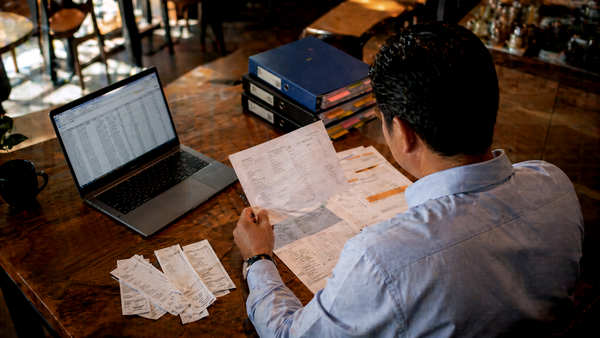
Customer copies. Merchant copies. Printed slips. Faded slips. Stapled slips. Folded slips. Receipts stuffed in bags, wallets, envelopes, folders, drawers, and close files.
At first, I saw the problem the way most people see it.
Paper receipts were annoying.
They were easy to lose. Easy to forget. Easy to damage. Easy to ignore until the exact moment you needed them.
If you had ever tried to claim an expense, return an item, explain a purchase, or find proof weeks later, you knew the feeling.
But over time, the problem became bigger than paper.
The real issue was not the receipt itself.
The real issue was proof.
Could the right person retrieve the evidence? Could they trust it? Could they explain it? Could they defend it when someone asked a hard question?
That is the question Proof of Purchase is built around.
That is when Proof of Purchase became more than an observation. It became a way to help finance teams move from chasing proof after the fact to having transaction evidence that is audit-ready by default.
The lesson I kept learning in Malaysia
My name is Curtis Johnson.
For more than four years, I served as Executive Director of MACEE, the Malaysian-American Commission on Educational Exchange.
That role took me across Malaysia. I worked with institutions, partners, businesses, universities, government stakeholders, community leaders, and people responsible for making complex programs work in the real world.
That work taught me something I now see everywhere:
Trust is not built only by good intentions.
Trust also depends on records.
It depends on follow-through.
It depends on whether you can explain what happened when someone asks a fair but difficult question.
In public-facing work, that lesson is obvious. If you manage programs, funds, partnerships, decisions, or institutional relationships, you learn quickly that trust needs evidence.
Not because people are cynical.
Because serious work has to be explainable.
That same lesson applies inside finance teams.
If you are responsible for close support, audit evidence, refund review, payment reconciliation, or e-Invoice support across multiple outlets, you already know this.
You are not just moving numbers.
You are protecting the business’s ability to explain itself.
A transaction may look small when it happens at the outlet.
A receipt may look like a routine document. A refund approval may look like a small operational step. A payment reference may look like a detail. A POS export may look like a file finance can always pull later.
But when close, audit, refund review, reconciliation, or compliance support arrives, those small records become proof.
And if the proof is scattered, inconsistent, delayed, or hard to retrieve, the burden does not disappear.
It lands somewhere.
In multi-outlet F&B businesses, it often lands on finance.
That is the part I care about most: the hidden burden your team carries when the business depends on proof, but the proof is not ready.
The problem was not just receipts
The first version of the problem was personal.
I kept getting paper receipts. I had to store them, photograph them, organize them, or hope I could find them later. For returns, I learned the hard way what happens when proof disappears.
That was irritating.
But irritation is not a business.
The business problem became clearer when I started looking at how proof works inside operating environments.
I spoke with restaurant managers who spent more than 30 minutes during nightly close, making sure the paper matched the register.
I saw how much manual effort still sat behind routines that looked simple from the outside.
I heard businesses talk through concerns as Malaysia moved toward e-Invoicing.
And the more I looked, the more obvious the pattern became.
The receipt was only one object in a larger evidence chain.
Finance did not just need a receipt.
Finance needed the ability to connect:
- what happened at the outlet
- what the POS recorded
- what the customer paid
- what the payment rail reported
- what eventually settled
- what was refunded or adjusted
- what supported the consolidated e-Invoice position
- what landed in the books
If those pieces could not be connected quickly, the team had a proof gap.
That changed the whole frame.
Because once you see the problem this way, the hero is not the technology, the receipt, or even the founder telling the story.
The hero is the finance team trying to bring order, defensibility, and trust to a messy operating system.
The question was no longer:
How do we get rid of paper receipts?
The better question was:
How do we make transaction evidence audit-ready by default?
Why Proof of Purchase focuses on finance workflow pain
Most businesses treat transaction evidence as admin.
Finance learns the truth later.
At the outlet level, a receipt, refund record, POS export, payment trail, or e-Invoice support file can feel small. It may sit inside a folder, inbox, payment portal, spreadsheet, or manager’s phone.
But finance does not experience those records one by one.
Finance experiences the system they create.
That system either makes a transaction easy to retrieve, explain, and defend — or it creates work.
The proof problem usually shows up later: during close, refund review, payment reconciliation, audit support, management reporting, or consolidated e-Invoice support.
That is why Proof of Purchase focuses on finance workflow pain.
The issue is not whether a document exists somewhere.
The issue is whether the right evidence is complete, consistent, retrievable, and usable when finance needs it.
If the team has to chase outlets, search folders, compare POS exports, request screenshots, or reconstruct refund trails after the fact, the business does not have audit-ready proof by default.
It has a workaround.
And over time, the workaround becomes the workload.
Why Malaysia is the right place to start
Proof of Purchase is starting in Malaysia because this is where the problem became real to me.
I have spent years traveling across the country, seeing how institutions and businesses operate, how trust is maintained, and how much serious work still depends on records, screenshots, exports, manual follow-up, and local operating discipline.
Malaysia is also at an important moment.
Multi-outlet F&B businesses are dealing with more payment methods, more systems, more customer expectations, and more compliance pressure.
An outlet may handle cards, QR payments, wallets, delivery platforms, cash, refunds, voids, adjustments, and different reporting routines.
Finance then has to turn that activity into a clean close, reliable support, and defensible records.
At the same time, consolidated e-Invoice expectations are forcing companies to think harder about whether their supporting evidence is actually ready when finance needs it.
That makes Malaysia the right starting point.
The larger opportunity may become regional.
But the first proof should be local, specific, and grounded in real operating conditions.
Proof of Purchase is not trying to solve all of ASEAN at once.
It is starting where your operating reality is most concrete: outlets, payment rails, refunds, close files, and evidence that has to stand up when someone asks for support.
The question I keep coming back to is:
Can multi-outlet F&B finance teams in Malaysia make receipt, refund, payment, settlement, GL, and consolidated e-Invoice evidence audit-ready by default across every outlet and payment rail?
That is where this work begins.
Why “digital” is not enough
A lot of conversations in this space stop too early.
They stop at paperless.
They stop at automation.
They stop at digital receipts.
Those things may help. But they do not solve the proof problem by themselves.
A digital record can still be incomplete.
A digital receipt can still be hard to retrieve.
A refund approval can still sit outside the finance workflow.
A payment report can still fail to connect cleanly to the POS record.
A settlement file can still require manual interpretation.
An e-Invoice support file can still be disconnected from the outlet-level evidence behind it.
Digital is not the same as audit-ready.
Stored is not the same as retrievable.
Uploaded is not the same as defensible.
That is why Proof of Purchase does not exist to celebrate paperless receipts for their own sake.
The focus is proof.
Whether finance can retrieve, trust, explain, and defend the evidence behind a transaction when the business needs to close, audit, refund, reconcile, or comply.
What Proof of Purchase is here to do
Proof of Purchase exists to make transaction evidence audit-ready by default for multi-outlet F&B finance teams in Malaysia.
That starts by making proof gaps visible.
A proof gap appears when the evidence behind a transaction is not ready when finance needs it.
Sometimes the record exists, but finance cannot find it quickly.
Sometimes the outlet record, payment record, settlement record, refund record, and GL entry do not connect cleanly.
Sometimes each outlet keeps evidence differently.
Sometimes the team can explain what happened only through memory, screenshots, and manual reconstruction.
Proof of Purchase is where I document these problems, name the patterns, build practical tools and language, and create tools for the people responsible for transaction evidence.
Not so the work sounds smarter.
So your work gets easier to explain, easier to defend, and easier to improve.
That includes essays, frameworks, diagnostics, and guided reviews for teams that need help finding where proof breaks and what to fix first.
The goal is not to make finance teams feel bad about messy evidence.
The goal is to make the hidden workload visible enough to fix.
Because if your team is already doing the hard work of protecting the numbers, the evidence system should support you. It should not make you carry the whole burden manually.
What I believe now
I believe receipts are not the emotional center of the problem.
They are one evidence object.
Important, yes.
But not enough on their own.
The stronger frame is transaction evidence.
Finance teams do not just need documents. They need evidence that survives the journey from outlet activity to payment movement to settlement to books.
They need proof that can support close.
Proof that can explain refunds.
Proof that can survive audit review.
Proof that can support consolidated e-Invoice requirements.
Proof that can be found without turning finance into a search party.
That is what audit-ready by default means.
It means the evidence is already organized, retrievable, reliable, and usable before pressure arrives.
Not because someone heroic stayed late.
Not because one person remembers where everything is.
Not because finance can always chase the outlet later.
But because the system was designed to make proof available when the business needs it.
That is the future Proof of Purchase is working toward.
A future where your team is not the last-minute search party for proof.
A future where finance can retrieve, trust, explain, and defend transaction evidence without rebuilding the story every time pressure arrives.
Start with the Proof Gap Diagnostic
If you manage finance, operations, audit support, payments, refunds, or e-Invoice evidence across a multi-outlet F&B business, Proof of Purchase is built for your world.
Because the people responsible for protecting the numbers should not have to fight the evidence system at the same time.
Start with the Proof Gap Diagnostic.
It will help you see where your transaction evidence process is most likely to break, retrieval, outlet consistency, payment matching, refund traceability, close support, or e-Invoice evidence readiness.
If your team is still chasing transaction proof across outlets, payment rails, refunds, and close folders, the first step is not another workaround.
The first step is seeing where the proof gap lives.